A roofing proposal for an HOA board is a formal document that presents the current roof condition, recommended scope of work, materials, costs, timeline, and compliance information, providing board members with the evidence they need to make an informed, defensible decision on behalf of the community.
In Florida, a weak proposal doesn't just slow approvals; it creates liability. Insurance eligibility, reserve adequacy, and community-wide risk all hinge on how well the decision is documented. At Best Roofing, we've helped Florida HOA boards navigate this process for over 47 years, translating inspection data into clear, board-ready proposals that withstand scrutiny.
What Is a Roofing Proposal for an HOA Board?
A roofing proposal for an HOA board is more than an estimate. It is a governance document one that supports fiduciary responsibility, regulatory compliance, and long-term asset protection for every owner in the association.
Because HOA and condominium roofs are shared common elements, proposals must account for community-wide impact. Individual preferences don't drive the decision; the proposal must justify the choice to owners, insurers, and auditors. For context on how the project unfolds once a proposal is approved, see our guide: HOA Roof Replacement: A Florida Board's Guide to Doing It Right.
Does an HOA Require Board Approval for Roof Replacement?
Yes. In most Florida HOA and condominium communities, roof replacement or major repair requires formal board approval even when the roof is a common element maintained by the association.
Boards must approve the funding source and budget, the scope of work, and the contractor selection. Starting work without approval can lead to project stoppages, insurance coverage disputes, owner complaints, and potential personal liability for board members who bypassed governance requirements.
A complete, well-structured roofing proposal is the board's protection against all of these outcomes.
What Do HOA Boards Look for in a Roofing Proposal?
HOA boards evaluate far more than price. They are assessing risk, longevity, and financial impact on every homeowner in the community.
A proposal that earns approval addresses the current roof condition and estimated remaining service life; the urgency of repair or replacement; Florida Building Code compliance and wind uplift requirements; budget impact on reserves and any potential special assessment; insurance implications of delaying or proceeding; and warranty coverage and ongoing maintenance obligations.
Boards that receive incomplete proposals routinely table decisions until the next meeting cycle, adding 30 to 60 days to a project that may already be urgent.
HOA Roofing Proposal Checklist
Every component below should be present before a proposal is submitted for board review. Missing items are the leading cause of approval delays.
|
Proposal Component |
What It Should Include |
Why It Matters To HOA Boards |
|
Roof Inspection Summary |
Roof age, condition photos, deficiencies, drainage assessment |
Establishes the factual basis for the decision |
|
Scope of Work |
Repair vs. replacement, included areas, exclusions |
Prevents disputes and uncontrolled change orders |
|
Roofing System Options |
Materials, manufacturers, colors, performance ratings |
Supports architectural consistency and code compliance |
|
Cost Breakdown |
Base cost, alternates, contingency, upgrades |
Enables reserve fund and assessment planning |
|
Project Timeline |
Start date, duration, phasing plan |
Minimizes resident disruption and complaints |
|
Code & Compliance |
Wind uplift rating, fire classification, permit plan |
Protects the association's liability and insurance eligibility |
|
Warranties |
Manufacturer coverage and workmanship terms |
Protects the long-term investment, learn what to look for |
|
Contractor Credentials |
Florida license, insurance, and HOA project references |
Reduces legal and performance risk |
|
Resident Communication Plan |
Notice schedule, access requirements, contact point |
Improves owner satisfaction and reduces board pressure |
How to Write a Roofing Proposal for an HOA Board
Step 1: Begin With a Professional Roof Inspection or Audit
Every credible proposal starts with documented evidence. Boards cannot make defensible decisions or justify them to owners without objective data on the roof's current condition.
A professional roof inspection should document roof type, age, service history, photos of deficiencies, drainage performance, and any storm-related damage. For communities evaluating long-term capital planning or managing multiple buildings, a roof audit provides deeper lifecycle analysis, including remaining service life estimates and projected replacement timelines, exactly the data that feeds accurate reserve studies.
To understand how often your roof should be inspected in Florida and what those inspections should include, see: Roof Property Management in Florida.
Step 2: Define the Scope With Zero Ambiguity
Vague scope language is the single most common cause of post-project complaints and unapproved change orders in HOA roofing projects.
The proposal must clearly state what is included and what is excluded; whether the project is repair, restoration, or full replacement; how tear-off and installation will be conducted; how the site will be protected and cleaned daily; and, for multi-building communities, how phasing will be sequenced to minimize disruption.
Step 3: Present Material Options, Not Just a Single System
HOA boards must maintain architectural consistency across the entire community. Proposals should present approved systems with manufacturer names, color options, and performance ratings rather than defaulting to a single recommendation.
Step 4: Provide Fully Transparent Costs and Financial Context
Boards must be able to explain every cost line to owners. Proposals should separate base costs from contingencies, include alternates and warranty upgrade pricing, and address how the project fits the association's reserve fund.
Rather than publishing cost ranges here, which shift based on system type, building access, and Florida code requirements, the following resources cover pricing by system: Flat Roof Replacement Cost and Tile Roof Replacement Cost in Florida. If financing is needed, Best Roofing's financing options may be available to qualifying associations.
Boards should also be aware that commercial roof replacements can have significant tax implications. Depending on the property structure and how the replacement is classified, costs may be deductible or eligible for credits, see Is Roof Replacement Tax Deductible? and Florida New Roof Tax Credit. This should be reviewed with the association's accountant before a project is finalized.
Step 5: Address Timeline, Phasing, and Resident Impact
Predictability prevents complaints. Proposals for multi-building communities should specify which buildings will be completed in which order, the weather contingency plan, the daily dry-in standards to be maintained, and how residents will be notified before and during construction.
Step 6: Include Credentials, References, and Warranty Terms
Boards are entrusting a contractor with a community-wide capital asset. Proposals should document Florida contractor licensing and insurance, proven HOA and multi-building project experience with referenceable contacts, manufacturer certification status, and both manufacturer and workmanship warranty terms in plain language.
How Long Does HOA Roofing Approval Take?
Most HOA roofing approvals take between 15 and 30 days. The timeline depends on board meeting schedules, what the governing documents require (some mandate multiple bids or a specific approval threshold), and the completeness of the submitted proposal.
Incomplete proposals are the leading cause of delayed approvals not board reluctance. A board that receives a proposal missing inspection documentation, a compliance statement, or a resident communication plan will almost always table it until the next cycle.
What Are the Insurance Implications of a Roof Decision?
This is one of the most underweighted topics in HOA roofing proposals and one of the most important to Florida boards.
An aging or deteriorating roof can affect the association's ability to obtain or renew coverage. Carriers in Florida increasingly require proof of the roof's condition and a documented maintenance history. Delaying a necessary replacement can put coverage at risk; proceeding with a properly documented replacement can support favorable renewal terms.
Before finalizing a proposal, boards should understand whether the age of the existing roof affects current coverage: Will Insurance Cover a 15-Year-Old Roof?
Florida-Specific Considerations for HOA Roofing Proposals
Florida's climate and building code requirements create obligations that proposals must address explicitly, not generically.
Wind uplift and edge metal. The Florida Building Code requires documented uplift resistance using assemblies with Florida Product Approval, Miami-Dade NOA, or FM-approved systems. Edge metal and perimeter attachment are statistically the first failure points during high-wind events. Wind Damage Roof Repair: What Florida Property Managers Need to Know covers what happens when these aren't properly specified.
Storm damage and insurance claims. If the project is triggered by a storm event rather than normal aging, the claim process involves the association's master policy, individual unit owner policies, and, if necessary, legal counsel.
Waterproofing and drainage. Clogged scuppers, low-drainage areas, and poor slope design all increase uplift pressure and accelerate roof deterioration in Florida's heavy-rain environment. Best Roofing's waterproofing services address these issues as part of a complete roofing scope.
Ongoing maintenance after installation. A new roof doesn't eliminate the need for structured maintenance. Most manufacturers require documented biannual inspections to keep warranties valid. Boards should require a post-installation commercial roof maintenance plan as part of the contractor agreement.
The Most Common HOA Roofing Complaints and How a Strong Proposal Prevents Them
Boards regularly field complaints about poor resident communication, unexpected change orders mid-project, site safety or cleanliness, color or material disputes after installation, and leaks that appear shortly after completion.
Every single one of these is preventable when the proposal addresses them in writing before work begins. A proposal that documents scope, materials, phasing, resident notices, and daily site management expectations removes the ambiguity that causes most post-project friction.
Frequently Asked Questions
Does every HOA require multiple contractor bids? Many governing documents do require multiple bids. Even when not required, comparative proposals demonstrate due diligence and support defensible decisions, particularly if owners later challenge the board's selection.
Can the HOA repair rather than replace? Sometimes. The decision depends on roof age, condition, and code requirements, all of which must be documented through inspection. In some cases, roof restoration or protective coatings extend the roof's life at significantly lower cost than replacement.
Who owns the roof in an HOA or condominium? Ownership varies by governing documents, but roofs are typically common elements that the association maintains and replaces. Boards should confirm ownership and maintenance obligations with legal counsel before approving any scope.
How does a roofing proposal support reserve studies? A proposal that includes inspection documentation, remaining service-life estimates, and projected replacement timelines supports accurate reserve planning. This reduces financial surprises and demonstrates responsible governance to owners, auditors, and lenders.
What should a board do after the project is complete? Close-out documentation, permits, warranties, as-built records, and a photo archive should be filed and retained. A structured roof property management program should then be established to maintain the roof, preserve warranty coverage, and keep the board informed of changes in condition over time.
Making Confident Roofing Decisions as an HOA Board
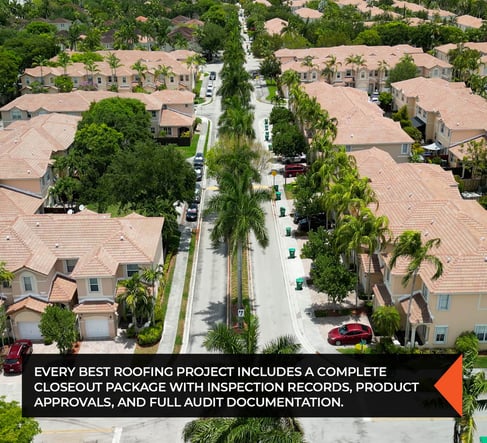
A roofing proposal that reaches your board incomplete will get tabled. One that arrives with inspection data, documented scope, Florida code compliance, and a resident communication plan gets approved and gives you the record to stand behind if owners or insurers ask questions later.
Best Roofing has supported HOA and condominium boards across Palm Beach, Broward, and Miami-Dade for nearly five decades. We complete 5,000+ re-roofing projects annually, handle 7,000+ service calls, and carry an $50M aggregate bonding capacity per project. The financial standing your board needs before signing a contract with any contractor. Our 31-step construction process produces the documentation your closeout package requires, from permit through final inspection.
We also offer CE-credited roofing courses and lunch-and-learns for property managers and board members. Not because we have to, but because a board that understands the process makes better decisions and faces fewer owner complaints.
Schedule your Bestimate, Best Roofing's FREE comprehensive roof inspection. We'll provide you with the inspection data, compliance documentation, and the complete proposal your board needs to move forward. Schedule a FREE Roof Inspection
Related Articles