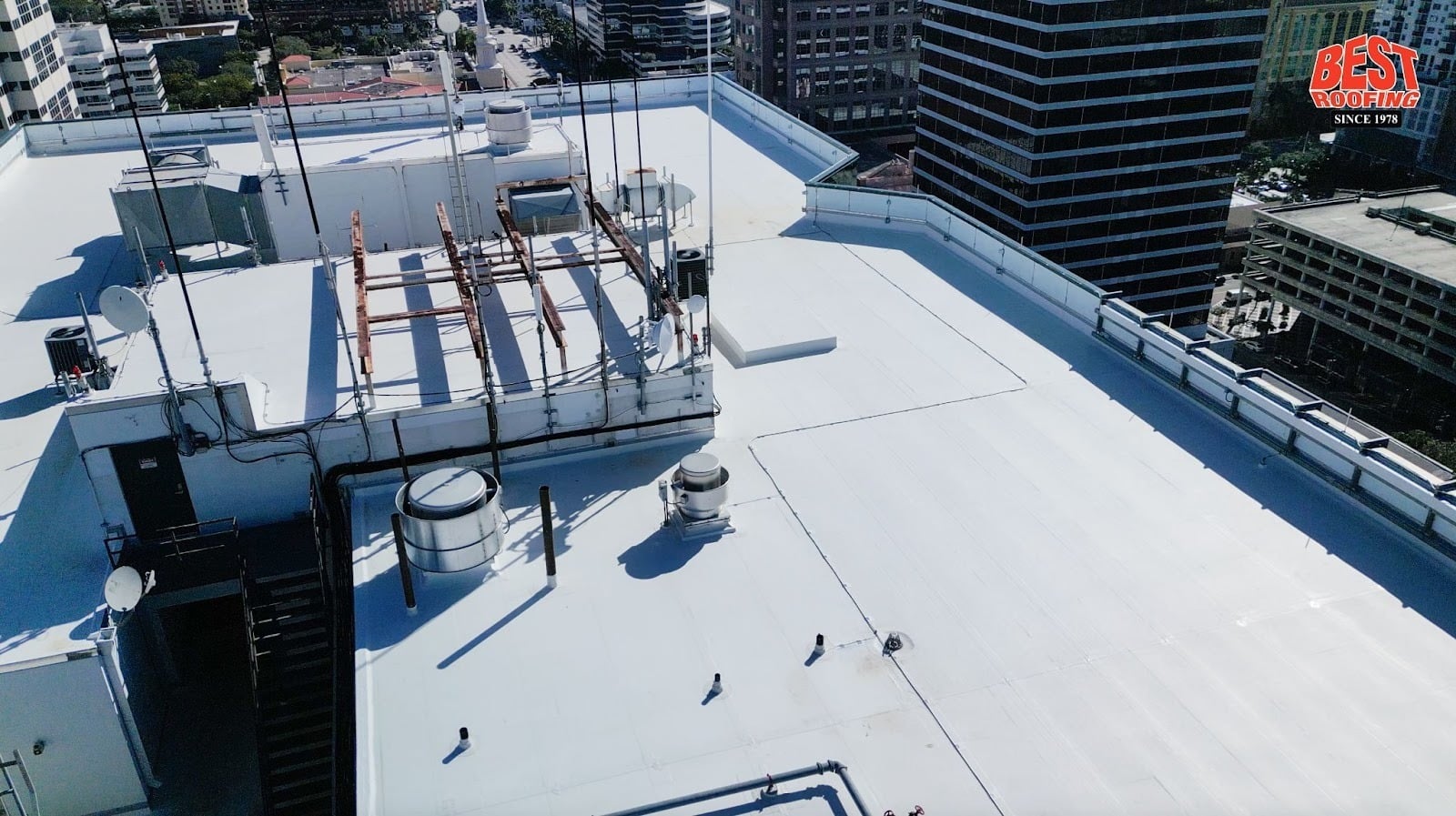
A leak above a retail sales floor doesn't stay a roofing problem for long. It can become a customer complaint, a damaged inventory claim, a tenant call, and a safety incident, sometimes all within the same afternoon. Retail roofs carry operational risks that most other commercial buildings don't, and in Florida's wind- and rain-prone environment, the margin for a poorly specified or undermaintained system is essentially zero.
The decisions that determine whether a retail roof performs system selection, penetration detailing, drainage design, and maintenance discipline must be made correctly before installation begins. Getting them right means years of uninterrupted tenant operations. Getting them wrong means recurring service calls and an early replacement.
At Best Roofing, we approach retail roofing as part of a broader asset management strategy. The right system reduces emergency service calls, stabilizes operating costs, and protects tenant continuity throughout the building's life.
Why Retail Buildings Have Unique Roofing Requirements
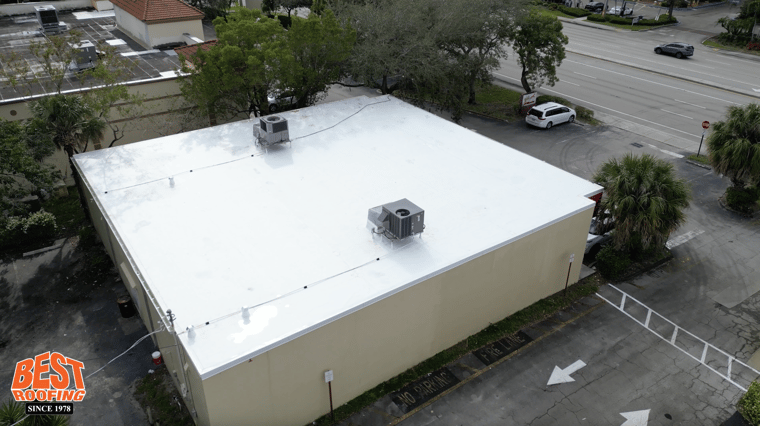
Not all commercial roofs carry the same operational risk. Retail properties face a combination of pressures that industrial or office buildings generally do not:
- Large flat roof areas are inherently vulnerable to ponding water if drainage is not correctly designed and maintained
- Dense rooftop penetrations for HVAC, exhaust, and mechanical equipment create multiple potential leak points requiring careful detailing
- Tenant operations run during business hours, limiting when work can be scheduled and how much disruption is acceptable
- A roof leak in front of customers creates immediate safety liability and reputational damage that a warehouse leak simply does not
In Florida, these baseline challenges are compounded by some of the most demanding environmental conditions in the country. Retail roofing assemblies must meet wind uplift requirements based on wind zone, fire resistance classifications, and drainage standards.
Most Common Roofing Systems for Retail Buildings
There is no single best roofing system for retail properties. The right choice depends on building design, roof slope, budget, code requirements, and long-term performance goals.
TPO
TPO commercial roofing is among the most widely specified systems on Florida retail properties, particularly for large shopping centers and plazas with low-slope roofs. Key advantages for retail include:
- Highly reflective white surface that reduces cooling loads across large conditioned spaces
- Heat-welded seams that provide strong performance when properly installed
- Cost efficiency at scale, making it attractive for portfolio owners managing multiple locations
- Strong alignment with Florida energy code requirements for commercial buildings
TPO must be carefully detailed at penetrations, edge metal, and drainage points to perform as designed.
Metal Roofing
Metal roofing is commonly specified on standalone retail buildings and mixed-use developments where the roofline contributes to architectural identity. Why retail owners choose metal:
- Service life often exceeds 40 years
- High resistance to wind, fire, and impact
- Lower long-term maintenance costs compared to most membrane systems
- Architectural flexibility for visible rooflines and brand recognition
The trade-off is a higher upfront installation cost and the need for qualified detailing at eaves, ridges, and wall intersections.
Built-Up Roofing (BUR)
Built-up roofing consists of multiple alternating layers of reinforcement and asphalt. It remains a viable option for certain retail applications because:
- Strong puncture resistance matters where HVAC technicians and maintenance crews frequently access the roof
- Long proven performance record on large flat commercial roofs
BUR does require more maintenance attention than single-ply systems.
Modified Bitumen
It is often selected for re-roofing projects where a proven, compatible system is required over existing substrates. Two-ply systems with a granule-surfaced cap sheet are common on retail properties and hold up well against Florida's thermal cycling and UV exposure.
Roof Restoration and Coatings
For retail properties where the existing roof structure is sound but the membrane is showing wear, restoring with elastomeric coatings can significantly extend service life at a fraction of the replacement cost. This option is worth evaluating before committing to a full replacement, particularly when the roof is mid-life, but maintenance frequency is increasing.
Roofing System Comparison for Retail Buildings
|
System |
Typical Lifespan |
Energy Efficiency |
Maintenance Level |
Wind Performance |
Best Retail Fit |
|
TPO |
20-30 years |
High |
Low to moderate |
Excellent when properly designed |
Shopping centers, retail plazas |
|
Metal |
40+ years |
Moderate |
Low |
Very high |
Standalone stores, mixed-use |
|
Built-Up (BUR) |
20-30 years |
Moderate |
Moderate |
Proven assemblies available |
High foot-traffic roofs |
|
Modified Bitumen |
20-25 years |
Moderate |
Low to moderate |
Strong with proper edge detail |
Re-roofing, retrofit projects |
|
Restoration/Coatings |
Extends 10-15 years |
High |
Low |
Depends on the base system |
Mid-life roofs in sound condition |
Florida Code Requirements Retail Owners Must Understand
Florida Building Code compliance is not optional, and the consequences of a non-compliant installation extend well beyond the initial inspection. Insurance carriers increasingly require documentation that a roof was installed to code, with permits pulled and closed. A roof without proper permitting or documented product approval can create coverage gaps that only surface when a storm claim is filed.
Key code considerations for Florida retail roofs include:
- Wind uplift resistance documentation using Florida Product Approval or Miami-Dade NOA assemblies
- Fire resistance classification for the roofing assembly
- Roof-to-wall connection detailing at parapets and edges
- Drainage adequacy for the total roof area
- Energy code compliance for insulation value and surface reflectivity
The Florida Department of Business and Professional Regulation maintains licensing requirements for roofing contractors. Verifying that your contractor holds a current, active license is a basic but important due diligence step before signing any contract.
How Rooftop Equipment Affects Retail Roof Performance
One of the most overlooked factors in retail roofing is the relationship between rooftop mechanical equipment and roof system performance. Most retail buildings carry significant HVAC loads, and the curbs, penetrations, flashings, and conduit runs supporting that equipment are among the most common sources of roof leaks.
Common equipment-related vulnerabilities include:
- Improperly curbed or inadequately flashed HVAC units
- Equipment was installed after the original roof without proper detailing
- Conduit and pipe penetrations sealed only with caulk rather than engineered flashing
- Rooftop foot traffic is wearing down the membrane around equipment access points
When evaluating roofing options, the scope of work should always include a complete assessment of all penetrations and rooftop equipment connections, not just the field membrane.
Lifecycle Cost vs. Upfront Price
The most common mistake in retail roofing decisions is optimizing for the lowest initial cost rather than the lowest total cost over the roof's service life. A cheaper system that requires frequent repairs, loses warranty coverage due to missed maintenance, or fails early can cost significantly more over a 20-year holding period.
Factors that determine total lifecycle cost:
- Initial installation quality and material selection
- Annual maintenance requirements and service contract costs
- Expected repair frequency based on system type and Florida exposure
- Warranty terms and what actually voids coverage
- Operational cost of tenant disruption during repairs or early replacement
A roof audit provides the data needed to assess the existing building, giving owners a clear picture of the remaining service life, projected maintenance costs, and replacement timing before committing to a scope of work.
The Importance of Drainage Design on Large Retail Roofs
Drainage is one of the highest-risk design elements on large flat retail roofs. Ponding water accelerates membrane degradation, adds structural load beyond design parameters, and increases the risk of sudden failure during Florida's heavy rain events.
A properly designed drainage system accounts for:
- Total roof square footage and required drain capacity
- Slope toward drains or scuppers
- Drain sizing, spacing, and secondary overflow provisions required by code
- Routine maintenance to keep drains clear of debris year-round
A drainage problem that develops gradually through settling, debris accumulation, or blocked drains can cause damage far exceeding the cost of the original drainage correction.
Can Retail Roofing Work Be Done While Stores Remain Open?
Yes, with proper planning. Retail roofing projects can and regularly do proceed while stores remain operational. The key factors are:
- A contractor experienced in phased scheduling around business hours
- Daily dry-in requirements to protect open interior areas overnight
- Odor and dust control measures appropriate for customer-facing environments
- Clear communication with store managers about access, noise windows, and safety perimeters
For a detailed look at how Best Roofing manages active retail environments during roofing projects, the retail commercial roofing process covers this in full.
Frequently Asked Questions
What type of roof is best for a retail building in Florida?
TPO and metal are the most commonly specified systems, but the best choice depends on the building's slope, size, budget, and code requirements. A professional assessment of your existing roof condition and long-term ownership goals should drive the decision.
How long does a retail building's roof last?
Most single-ply and modified bitumen systems last 20 to 30 years with proper maintenance. Metal systems often exceed 40 years. Roofs that receive consistent biannual inspections and preventive maintenance regularly outperform their rated lifespans.
How often should a retail roof be inspected?
At least twice per year and after any significant storm event. A pre-season inspection in late spring and a post-season inspection in November are a sensible baseline for Florida. Professional roof inspections document condition, catch developing issues early, and provide the maintenance records many warranty programs require.
What causes most retail roof failures in Florida?
The most common causes are:
- Ponding water from inadequate or poorly maintained drainage
- Improperly detailed penetrations around HVAC equipment
- Deferred maintenance allows small issues to develop into system failures
- Edge metal or perimeter attachment failures during high-wind events
Is roof restoration a viable option for retail buildings? Often yes. If the existing roof deck is structurally sound and the membrane has not reached the end of life, a restoration coating can extend performance by 10 to 15 years at significantly lower cost than full replacement. A thorough inspection is required to determine eligibility.
Making a Confident Roofing Decision for Your Retail Property
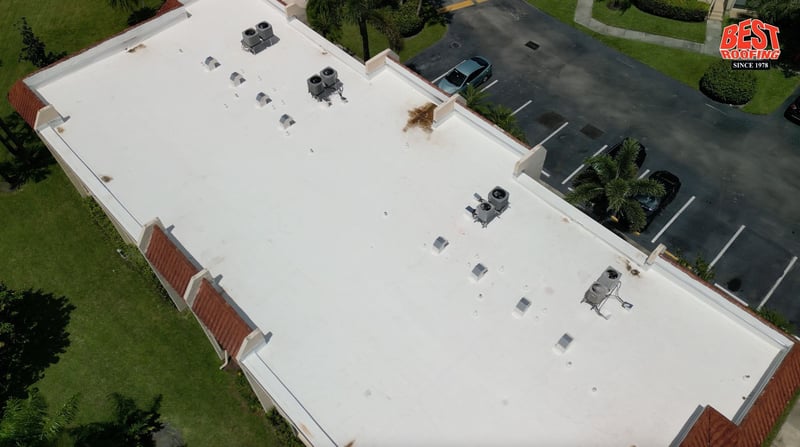
A retail roof that performs reliably doesn't happen by accident. It starts with the right system selection, code-compliant installation, and a maintenance program that keeps warranties valid and small issues from becoming expensive ones.
The risk for a retail property differs from that of other commercial buildings. Tenant continuity, customer safety, and lease obligations mean there is no good time for a roof failure and no acceptable margin for a contractor who shows up unprepared for a live retail environment. Best Roofing has managed roofing projects on occupied retail centers, shopping plazas, and mixed-use properties across Palm Beach, Broward, and Miami-Dade for over 47 years. We know how to phase a project around store hours, meet daily dry-in requirements, and close out a job with the documentation your insurance carrier and tenants expect.
If your retail property is due for an inspection, approaching replacement, or dealing with a recurring leak around rooftop equipment, start with a Bestimate, Best Roofing's FREE comprehensive roof inspection for an objective assessment of what you're actually working with. Schedule a FREE Roof Inspection
Related Articles