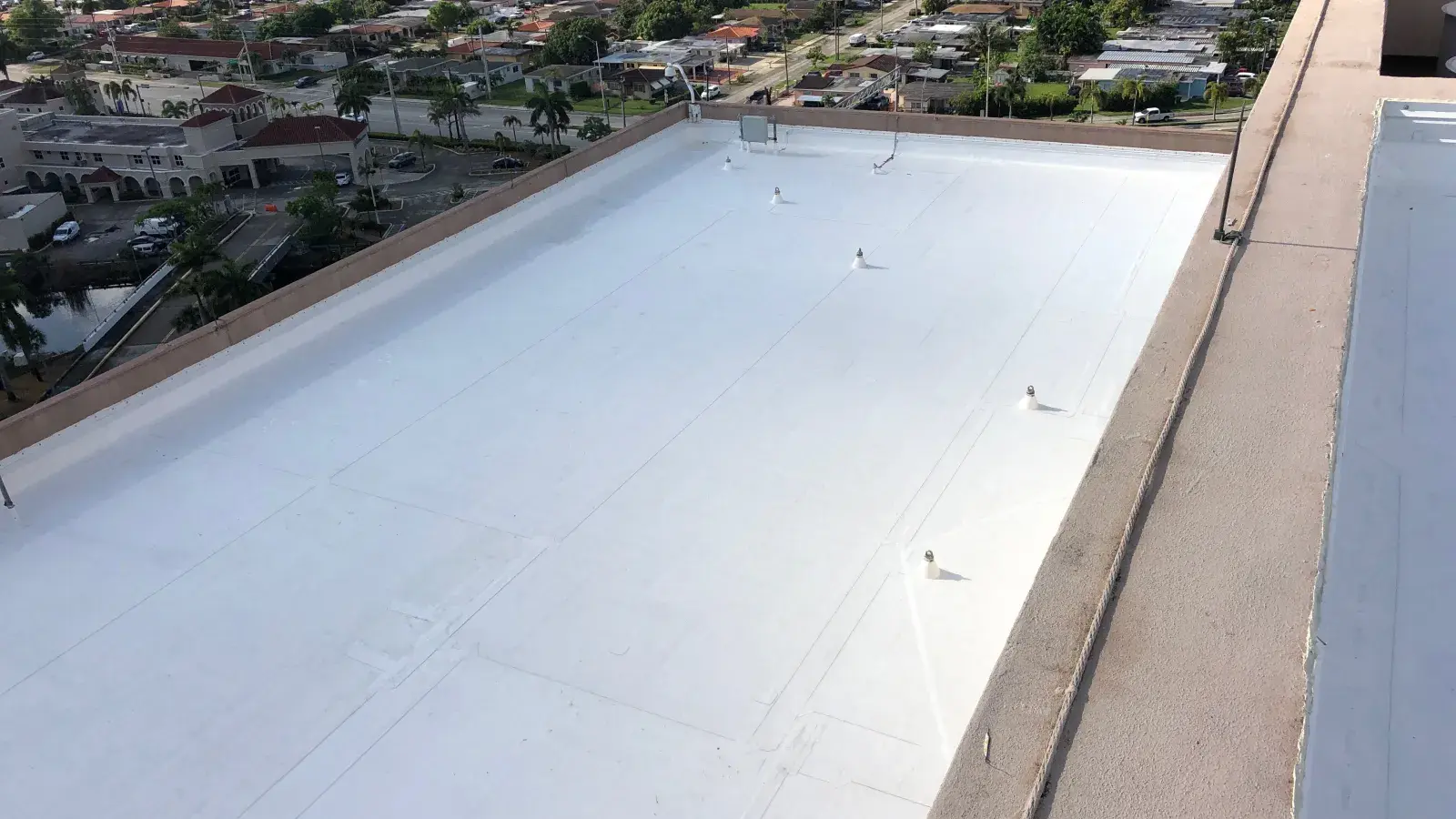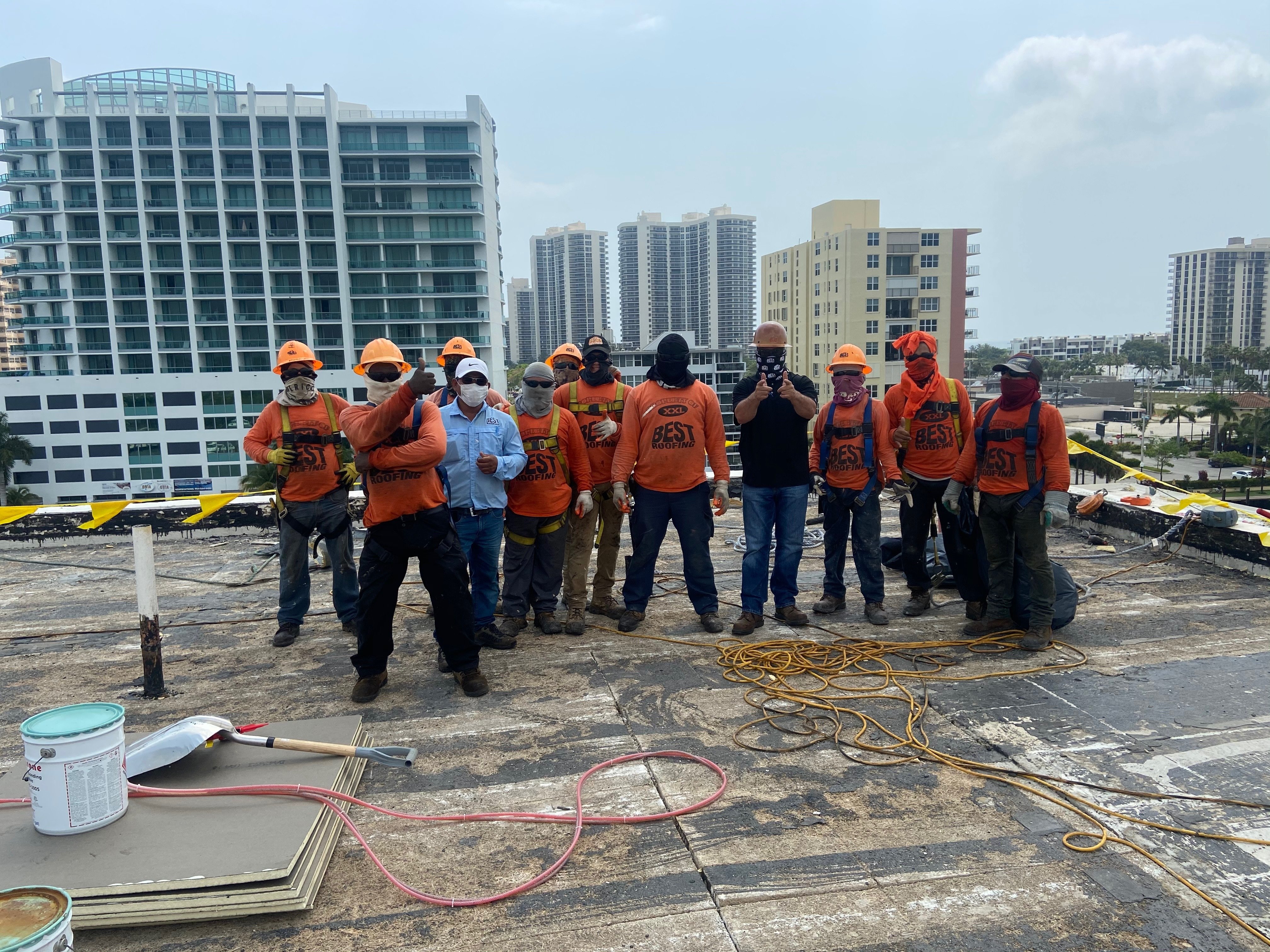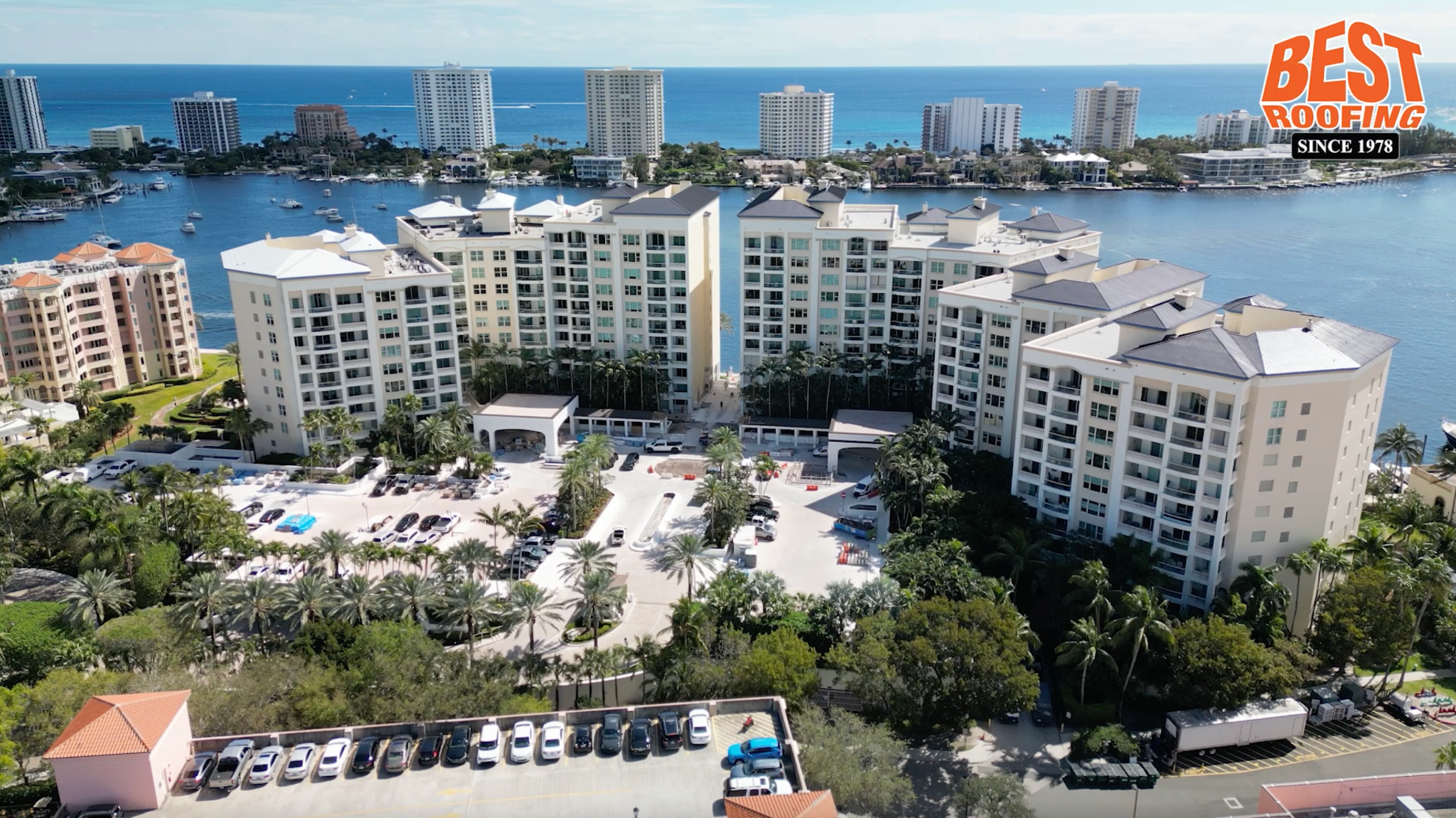

A warehouse roof is one of the largest single assets on your property and one of the most consequential decisions you'll make for long-term operating costs. The wrong system doesn't just leak. It damages inventory, triggers business interruption, and creates unplanned capital expenditure at the worst possible time.
This guide covers the systems, real South Florida costs, and the decisions that separate a roof that performs for 30 years from one that becomes a problem in ten.
Why Warehouse Roofing Is a Different Decision
Warehouse and industrial roofs carry demands that most commercial buildings don't.
- Scale 50,000 to 500,000+ sf of continuous low-slope surface amplifies every design variable: drainage run lengths, wind pressure differentials, and equipment load distribution
- Operational zero-tolerance, a single leak can damage millions in inventory and force operational shutdowns; roofing work itself must be sequenced around active dock access, cold storage, and production schedules
- Rooftop complexity, HVAC units, exhaust systems, skylights, and mechanical supports multiply penetration points and maintenance foot traffic
The roofing decisions that work for an office building or retail strip center don't automatically translate to an industrial facility. System selection, specification thickness, and maintenance planning all need to reflect how your building actually operates.
Two FBC Requirements Most Warehouse Owners Miss
Before comparing systems, two compliance triggers are particularly relevant for warehouse re-roofing projects.
1. The structural weight trigger
Under FBC Section 1511.1.1, adding more than 10% to the existing roof's dead load requires a licensed structural engineer to verify deck capacity before work begins. This most commonly catches owners off guard when switching system types or adding insulation layers to meet current code minimums. Discovering it after the tear-off has started stops the project and compresses the schedule under cost pressure. Commission a structural assessment before you start.
2. HVHZ product approval specificity
For warehouses in Miami-Dade or coastal Broward, every product in the roofing assembly must carry a current Miami-Dade NOA tied to the exact installation method being used. The same membrane carries different approvals for mechanically fastened vs. fully adhered applications. A product approved for one method is not automatically approved for another, and "FBC-compliant" without a specific NOA number does not satisfy HVHZ documentation requirements.
Roofing Systems for Industrial Warehouses
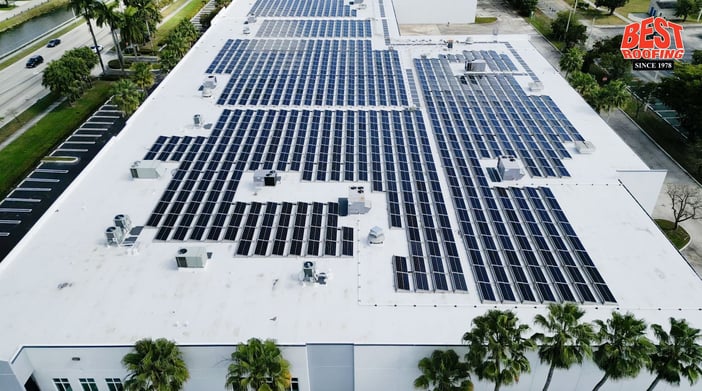
TPO The Volume Standard
TPO dominates large commercial and industrial roofs in Florida because it delivers reliable performance at a cost that scales well across large square footage. A reflective white surface reduces cooling loads, a significant benefit for a 200,000 sf building running HVAC year-round.
- Specify 60-mil as the commercial baseline
- Specify 80-mil for roofs with regular equipment access or foot traffic
- Best fit: distribution centers, logistics facilities, general warehousing
See TPO vs. PVC and TPO commercial roofing in Florida.
PVC Chemical and Exhaust Environments
Where rooftop exhaust, grease, or industrial solvents are present, PVC is the correct specification, not an upgrade. Its chemistry resists degradation that TPO cannot.
- Best fit: food processing, manufacturing, facilities with rooftop exhaust systems
- Requires documented plasticizer retention data. Ask for it before specifying
KEE Long-Term Integrity Without Compromise
KEE eliminates PVC's primary long-term failure mode, plasticizer migration, while matching its chemical resistance profile. It costs more upfront and earns it back through sustained material performance over time.
- Best fit: facilities where roof replacement is highly disruptive and long-term integrity is the priority
Metal: The Long Play
Metal roofing makes financial sense when you own the building long-term and are optimizing total cost rather than installation price. Standing seam systems with concealed fasteners and a current Miami-Dade NOA meet the wind uplift resistance demands of HVHZ and eliminate fastener-penetration failure modes that affect exposed-fastener systems over time.
- Service life: 40–60+ years
- Best fit: owner-occupied facilities, long-term holds, buildings pursuing solar integration
- Higher upfront cost; lowest 40-year total cost of any system on this list
See Best Roofing's metal roofing systems.
Modified Bitumen Built for Foot Traffic
Multi-ply construction gives Modified Bitumen the best puncture resistance of any system, essential for roofs accessed frequently for HVAC servicing, equipment maintenance, or operational needs.
- Best fit: high-traffic roofs, facilities prioritizing redundant water-tight layers
- Budget approximately $0.04–$0.05/sf annually in maintenance; plan for recoating every 10–12 years
See the TPO vs. Modified Bitumen and Built-Up Roof guide.
Roof Coatings Before You Commit to Replacement
If the existing membrane is structurally sound and dry, a high-performance roof coating can extend service life by 5–15 years at $3–$6/sf, a fraction of the full replacement cost. An infrared moisture scan determines whether the substrate is suitable for this approach. Never assume coating a failing or wet substrate accelerates deterioration.
System Comparison
|
System |
Lifespan |
Foot Traffic |
Chemical Resistance |
Best Fit |
|
TPO |
20–30 yrs |
Moderate |
Moderate |
Large flat warehouses |
|
PVC |
20–30 yrs |
Moderate |
High |
Chemical/exhaust exposure |
|
KEE |
20–30+ yrs |
Moderate |
High |
Long-term integrity |
|
Metal (Standing Seam) |
40–60+ yrs |
Low |
High |
Long-term ownership |
|
Modified Bitumen |
20–25 yrs |
High |
Moderate |
High foot-traffic roofs |
|
Roof Coating |
+5–15 yrs |
Moderate |
Varies |
Sound substrate, cost deferral |
Real South Florida Costs (2025–2026)
Installed cost ranges by system:
|
System |
Cost per SF |
|
TPO 60-mil, mechanically fastened |
$8–$12 |
|
TPO 80-mil, fully adhered |
$10–$14 |
|
PVC |
$9–$14 |
|
KEE |
$12–$17 |
|
Modified Bitumen (2-ply torch-applied) |
$9–$13 |
|
Metal standing seam |
$14–$21+ |
|
Roof coating |
$3–$6 |
See Best Roofing's commercial roof replacement cost guide for full project breakdowns.
What Pushes Costs Higher on Industrial Projects
- Penetration density: Each HVAC curb or pipe penetration adds $200–$500 in labor and flashing; a roof with 40 units is fundamentally different from one with 10
- Tear off when existing layers must be removed, add $1.50–$3.00/sf; on a 100,000 sf roof, that's $150,000–$300,000 before materials
- Occupied building logistics phased execution around active operations extends schedules and adds labor cost
- HVHZ compliance wind uplift calculations, NOA verification, and documentation for Miami-Dade and coastal Broward projects add real cost that does not exist outside the hurricane zone
The Lifecycle Cost Mistake
Owners who select solely on upfront cost often end up with a system that requires full replacement at year 18 instead of year 30 at a higher cost, with the disruption of a second project during active operations. Total cost of ownership, installation, maintenance, energy impact, and replacement timing should guide industrial roofing decisions.
Energy and Financial Incentives
Reflective roofing and cooling costs
White TPO, PVC, and KEE membranes that meet Energy Star thresholds reduce rooftop heat absorption and HVAC load year-round, measurably so, across 50,000–500,000 sf.
Federal Section 179D
Warehouse owners installing roofing systems that improve energy performance beyond the FBC insulation baseline may qualify for the federal Section 179D Energy Efficient Commercial Buildings Deduction, active through mid-2026. Eligibility requires an energy analysis by a certified modeler. Direct Section 179D eligibility to your tax advisor.
Wind mitigation discounts
Roofing systems with documented wind-resistance features, ANSI/SPRI ES-1 edge metal, confirmed NOA compliance, and zone-calculated fastening patterns may qualify for wind mitigation premium discounts through your property insurer. Provide your broker with the completed wind mitigation report from your inspection.
See Best Roofing's inspection services for what that documentation covers.
Quick Decision Framework
|
Your situation |
Right direction |
|
Large flat warehouse, energy focus, no chemical exposure |
TPO 60-mil or 80-mil |
|
Rooftop exhaust, grease, or chemical exposure |
PVC or KEE |
|
Long-term ownership, optimizing lifecycle cost |
Metal standing seam |
|
High foot traffic from the ongoing equipment service |
Modified Bitumen, 2-ply minimum |
|
The existing roof is structurally sound, with surface wear only |
Inspection first coating may be the answer |
How Best Roofing Works on Industrial Projects
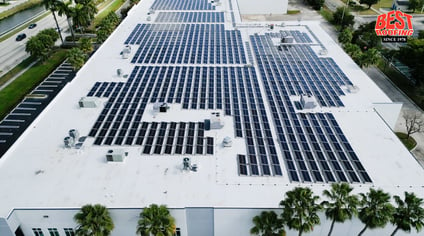
When the buyer of the largest Miami industrial sale of 2010 needed a 127,010 sf warehouse re-roofed before tenants moved in, Best Roofing completed the project from permit to completion in under 30 days. View the warehouse and industrial project portfolio.
What we provide for warehouse owners and facility managers:
- System evaluation and selection grounded in South Florida field performance, not manufacturer literature
- FBC and HVHZ compliance documentation, NOA verification, structural weight assessment, and permit documentation before work begins
- Lifecycle planning and capital forecasting, total cost of ownership analysis, built for board presentations and asset management cycles
- Preventative maintenance programs with documented condition reporting
- 24/7 emergency response when a roof fails during hurricane season
Not just certified GAF Master Elite, Carlisle Authorized Applicator, and Tremco Elite Certified.
Common Questions
What is the best roofing system for a Florida industrial warehouse?
TPO at 60-mil or 80-mil for most large flat warehouses. PVC or KEE, where chemical exposure is a factor. Metal standing seam for long-term owners, optimizing lifecycle cost.
How much does warehouse roofing cost in South Florida?
$8–$21+/sf installed depending on system, substrate condition, HVHZ requirements, tear-off scope, and rooftop complexity.
How long does a warehouse roof last?
TPO, PVC, and Modified Bitumen: 20–30 years. Metal: 40–60+ years.
How often should a warehouse roof be inspected?
Twice per year, spring and fall, plus after any significant storm.
Does a re-roof trigger a structural engineering review?
Yes if the project adds more than 10% to the existing dead load (FBC Section 1511.1.1). Commission the assessment before work begins, not after the tear-off.
Can a warehouse roof be restored instead of replaced?
Sometimes. An infrared moisture scan determines whether the substrate is suitable for coating. A visual inspection alone is not sufficient to make that call.
Making the Best Warehouse Roofing Decision
Commercial roofing for industrial warehouses is a long-term operational decision, not just a construction task. The right system protects inventory, supports operations, and stabilizes long-term costs.
If you are planning a replacement, evaluating an aging roof, or managing multiple warehouse assets, start with a Bestimate, Best Roofing's FREE comprehensive roof inspection with Best Roofing. We help you make informed, defensible roofing decisions built for Florida conditions and long-term performance. Schedule a FREE Roof Inspection
Related Articles