
Last Updated on April 30, 2026
TPO roofing is a single-ply commercial roofing membrane made from thermoplastic polyolefin, installed in large heat-welded sheets on flat and low-slope roofs to create a continuous, waterproof, and highly reflective surface. It is one of the most widely specified commercial roofing systems in Florida due to its energy efficiency, competitive cost, and strong performance in hot, humid climates.
If you manage or own a commercial property in Florida, this guide provides clear, comprehensive answers to common questions about TPO so you can make a confident, informed decision.
TPO Roofing at a Glance
|
Full name |
Thermoplastic polyolefin |
|
Roof type |
Single-ply membrane, flat and low-slope |
|
Typical lifespan |
15 to 25 years |
|
Key benefit |
Reflects heat, reduces cooling costs |
|
Key risk |
Performance depends heavily on installation quality |
|
Best for |
Large commercial buildings in hot climates |
What Does TPO Stand For?
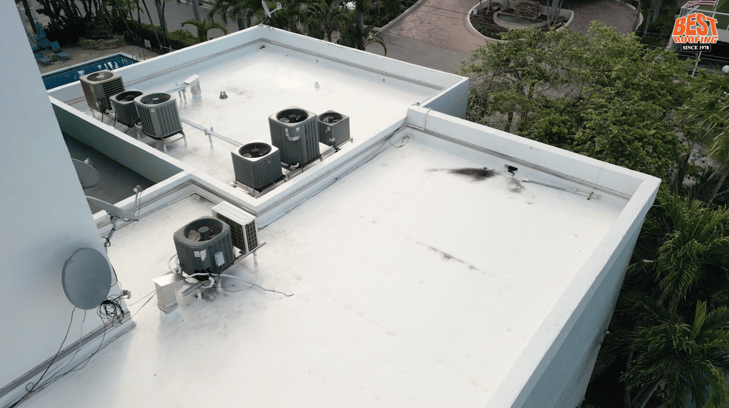
TPO stands for thermoplastic polyolefin, a material engineered specifically for flexibility, durability, and heat resistance. The membrane is primarily made from a blend of polypropylene and ethylene-propylene rubber, along with reinforcing fillers and additives that enhance flexibility, durability, and UV resistance.
The result is a roofing membrane that holds up under Florida's extreme UV exposure, temperature swings, and heavy rainfall while remaining cost-competitive with alternative systems.
What Is a TPO Roofing System Made Of?
A complete TPO roofing system is not just the membrane. It is a layered assembly where each component plays a specific role:
- Structural roof deck — the foundation that the entire system sits on
- Insulation layer — controls thermal performance and contributes to energy code compliance
- TPO membrane — the primary waterproofing and reflective surface
- Fastening or adhesive system — mechanically fastened, fully adhered, or ballasted, depending on wind zone and design
- Heat-welded seams — fuse overlapping sheets into a single continuous waterproof surface
Seam welding is one of the defining characteristics of TPO. A properly welded seam is often stronger than the membrane itself. This is also where installation quality has the greatest impact on long-term performance.
Commercial vs Residential:
- Commercial buildings use large-scale continuous membrane systems.
- Residential applications are limited to flat or low-slope areas, such as additions, patios, or modern home designs.
What Colors Does TPO Roofing Come In?
TPO is available in white, gray, and tan. In Florida, white is by far the most common specification because:
- White reflects a high percentage of solar radiation, typically in the range of 0.70 to 0.85 depending on the product and whether values are initial or aged.
- It supports compliance with the Florida energy code for commercial buildings.
- It reduces cooling loads across large conditioned spaces, which directly lowers operating costs.
Gray and tan are used when aesthetics, building design requirements, or specific architectural standards require an alternative to white.
Commercial vs Residential:
- Commercial: color is driven by energy performance
- Residential: aesthetics may play a larger role in selection
TPO Roofing and Florida Energy Code Compliance
This is one of the most practically important aspects of TPO for Florida commercial property owners, and one of the most overlooked.
Florida's Energy Code for commercial buildings, which is based on ASHRAE 90.1 requirements, sets minimum solar reflectance and thermal emittance standards for low-slope roofing on conditioned buildings. White TPO membranes from leading manufacturers consistently meet and exceed these thresholds, making TPO one of the most straightforward systems to specify for energy code compliance.
Roof membrane performance is independently rated by the Cool Roof Rating Council (CRRC), which measures and publishes solar reflectance and thermal emittance values for tested products. When specifying TPO for a Florida commercial project, confirming that the product carries a current CRRC rating ensures the assembly meets energy code requirements and supports permit documentation.
Key metrics to understand:
- Solar reflectance measures how much sunlight is reflected away from the roof surface. White TPO typically rates between 0.79 and 0.87, meaning it reflects 79 to 87 percent of solar energy
- Thermal emittance measures how efficiently the roof releases absorbed heat. High emittance values, typically 0.90 and above for white TPO, mean the roof cools quickly after the sun sets
According to the U.S. Department of Energy, cool roofs can reduce roof surface temperatures by up to 50 degrees Fahrenheit under peak sun conditions compared to conventional dark surfaces, directly reducing cooling energy consumption in buildings like those found throughout Florida.
Commercial vs Residential:
- Commercial buildings must meet strict energy code thresholds
- Residential properties are not always subject to the same requirements, but still benefit from reduced cooling costs
Wind Uplift, Attachment Methods, and Florida Wind Zones
Attachment method is one of the most consequential decisions in a TPO specification, particularly in Florida, where wind design requirements vary significantly by location.
Florida is divided into wind zones based on design wind speed. Properties in the High Velocity Hurricane Zone covering Miami-Dade and Broward counties face the most stringent requirements, with design wind speeds reaching 170 mph in certain coastal areas. Every roofing assembly installed in these areas must carry a valid Miami-Dade Notice of Acceptance (NOA) or Florida Product Approval, and that approval must match the exact assembly and attachment method used on the project.
The three primary TPO attachment methods each carry different wind uplift performance characteristics:
Mechanically fastened
- The membrane is secured to the deck with screws and plates at defined spacing
- Fastening density is calculated separately for field, perimeter, and corner zones, each of which carries different design pressures under ASCE 7-22 wind load requirements
- Cost-effective for large roof areas and commonly used across Florida
- Uplift resistance depends on fastener spacing and deck substrate quality
Fully adhered
- The membrane is bonded continuously to the insulation or cover board using adhesive
- Eliminates the fastener pullout vulnerability of mechanically fastened systems
- Often specified where maximum wind uplift resistance is required or where deck substrate conditions make mechanical fastening less reliable
- Higher installation cost but stronger performance in the highest wind zones
Ballasted
- The membrane is held in place by stone or concrete pavers
- Rarely used in Florida due to wind uplift exposure, added structural load, and HVHZ restrictions
Selecting the wrong attachment method for the wind zone, or using a product without the required NOA for an HVHZ project, creates code compliance failures that are expensive and disruptive to correct after installation begins
Commercial vs Residential:
Commercial roofs require engineered wind uplift calculations and approvals
Residential flat roofs may use similar systems but with less complex design requirements
In high-risk areas like Miami-Dade, systems must meet strict approval standards regardless of property type.
Insulation Options Under TPO
The insulation layer beneath a TPO membrane directly affects thermal performance, energy code compliance, moisture management, and long-term system durability. It is not a secondary decision.
The two most common insulation types used under TPO in Florida are:
Polyisocyanurate (ISO)
- The most widely used commercial roof insulation in the U.S., according to the National Roofing Contractors Association (NRCA)
- Offers the highest R-value per inch of any commonly available roofing insulation, typically R-5.6 to R-6.5 per inch
- In Florida's hot climate, ISO must be installed with a cover board to protect it from heat-related R-value reduction at high temperatures, a phenomenon known as thermal drift
- Provides a smooth, stable substrate for TPO adhesion in fully adhered systems
Expanded Polystyrene (EPS)
- Offers stable R-value performance across temperature ranges with no thermal drift
- Less susceptible to moisture-related performance loss than ISO when properly installed, which matters in Florida's high-humidity environment
- Lower R-value per inch than ISO, typically R-3.6 to R-4.2, but performance is more consistent over time
- A strong choice for Florida projects where long-term moisture management is a priority
The right insulation choice depends on the building's thermal requirements, the specified attachment method, budget, and the specific Florida energy code compliance path being used. A qualified contractor will evaluate all of these factors rather than defaulting to a single product.
TPO Membrane Thickness: Which Should You Specify?
TPO membranes are manufactured in three primary thicknesses: 45-mil, 60-mil, and 80-mil. The number refers to the membrane's thickness in thousandths of an inch. This decision has a direct impact on durability, warranty coverage, and long-term performance.
|
Thickness |
Durability |
Common Use |
Florida Recommendation |
|
45-mil |
Lowest |
Light-duty, budget applications |
Not recommended for most Florida roofs |
|
60-mil |
Moderate to good |
Standard commercial specification |
Appropriate for most Florida commercial & residential buildings |
|
80-mil |
Highest |
High-traffic or high-performance applications |
Recommended for HVHZ, heavy-use roofs, or long warranty requirements |
Specifying the thinnest available option to reduce upfront cost is one of the most common mistakes in commercial TPO procurement. The cost difference between 45-mil and 60-mil at installation is minor relative to the performance difference over a 20-year holding period.
How Long Does a TPO Roof Last?
A properly installed and consistently maintained TPO roof typically lasts 15 to 25 years in Florida. The factors that most determine where in that range your roof lands are:
- Installation quality — the single biggest variable; improper seam welding or inadequate flashing dramatically shortens lifespan
- Membrane thickness — 60-mil and 80-mil membranes significantly outlast thinner 45-mil options under Florida conditions
- Drainage design — ponding water accelerates membrane degradation faster than almost any other factor
- Maintenance consistency — roofs that receive biannual inspections and prompt minor repairs regularly reach or exceed the top of the range
What Are the Benefits of TPO Roofing?
- Energy efficiency — the reflective surface reduces heat gain and can meaningfully lower cooling costs on large commercial buildings
- Strong waterproofing — heat-welded seams provide strong, consistent performance compared to mechanically bonded or adhesive-only joints when installed correctly under Florida wind and rain exposure
- Cost efficiency at scale — TPO is generally more cost-effective than PVC on large roof areas while delivering comparable energy performance
- Flexibility — the membrane accommodates building movement and thermal cycling without cracking
- Recyclability — TPO is considered recyclable, though availability depends on local facilities and project conditions.
Commercial vs Residential:
- Commercial: benefits scale significantly due to roof size
- Residential: benefits are more localized but still valuable
What Are the Common Issues With TPO Roofing?
Most TPO problems stem from poor installation or deferred maintenance, not the material itself. The most common issues are:
- Seam failure from improper heat welding or seams that were not fully fused during installation
- Membrane punctures at penetrations or areas of rooftop foot traffic
- Ponding water from drainage systems that were inadequately designed or not maintained
- Flashing separation at walls, curbs, and penetrations where the membrane transitions to a vertical surface
- Shrinkage or splitting in older membranes that have reached end of life or experienced UV fatigue
The right contractor and a disciplined maintenance program prevent the majority of these issues.
When Is TPO Not the Right Fit?
TPO is a strong choice for most commercial flat roofs in Florida, but it is not ideal for every situation. Consider an alternative if:
- The property has significant rooftop chemical exposure from exhaust, grease, or industrial processes, where PVC's superior chemical resistance is a better match
- Drainage problems are unresolved, since no membrane system performs well under persistent ponding
- The roof carries very heavy or frequent maintenance traffic that requires the additional puncture resistance of a modified bitumen system
- The project falls under HVHZ requirements, and the specified assembly does not carry the required Miami-Dade NOA
For a direct comparison of when to choose TPO versus PVC, the TPO vs PVC breakdown covers the trade-offs by building type and use case.
Residential consideration:
TPO is not suitable for steep-slope homes that require shingles or tile systems.
What Maintenance Does a TPO Roof Require?
TPO is a relatively low-maintenance system compared to multi-ply alternatives, but it is not maintenance-free. A consistent program includes:
- Biannual inspections — before and after hurricane season- are the practical baseline for Florida
- Drain and scupper cleaning — debris buildup is one of the most common causes of ponding on flat commercial roofs
- Seam and flashing checks — catching early separation before water infiltrates is far less costly than reactive repair
- Prompt minor repairs — small membrane punctures or flashing gaps addressed quickly prevent interior damage and warranty complications
Most manufacturer warranties on TPO systems require documented maintenance to remain valid. Professional roof inspections provide the documentation needed to protect that coverage.
TPO Restoration vs. Replacement
When a TPO roof is mid-life but showing signs of wear, full replacement is not always the only option. If the existing membrane is structurally sound and the deck is undamaged, an elastomeric restoration coating applied over the existing TPO can extend service life, often in the range of 10 years depending on conditions and system quality
Eligibility for restoration depends on a thorough inspection to confirm that the membrane has no significant seam failures, that the insulation beneath is dry, and that the overall system is structurally sound. A roof that is genuinely at the end of its life, has wet insulation, or has significant seam failures is not a candidate for restoration and should be replaced rather than coated over.
Roof restoration is worth evaluating before committing to a full replacement scope, particularly for properties managing capital expenditure timing.
TPO Roofing and Florida Insurance Considerations
A properly installed and documented TPO roof can support a commercial property's insurability in Florida's challenging insurance market. Carriers operating in Florida increasingly scrutinize roof age, condition, and documentation when underwriting or renewing commercial policies.
A new TPO installation with proper permits, closed inspections, product approval documentation, and a maintained inspection record provides the evidence underwriters want to see. Conversely, a roof that lacks documentation, has open permits, or shows signs of deferred maintenance creates underwriting risk that can affect coverage availability and premium.
If your existing roof is approaching or past 15 years, understanding how age affects your current coverage before specifying a replacement system is a useful step. The insurance coverage guide for aging roofs covers what Florida carriers typically look for and how roof condition affects policy terms.
What to Look for in a TPO Roofing Contractor
TPO's performance ceiling is determined almost entirely by installation quality. Selecting the right contractor matters more with TPO than with some other systems because the heat-welding process requires properly calibrated equipment, trained operators, and consistent quality control. Mistakes are not always visible at inspection and may not produce leaks until months or years later.
When evaluating a TPO contractor in Florida, look for:
- Active Florida roofing license — verify at the Florida Department of Business and Professional Regulation
- Manufacturer certification — GAF Master Elite, Carlisle Authorized Applicator, or equivalent designations indicate the contractor has been vetted and trained by the manufacturer whose product they are installing
- HVHZ experience — if your project is in Miami-Dade or coastal Broward, the contractor must understand NOA requirements and how to document compliance
- Documented quality control process — ask how seam welds are tested and what the inspection protocol is during installation
- Verifiable references on comparable projects — a contractor who has installed TPO on buildings similar to yours in scale and occupancy is meaningfully lower risk than one who has not
- Clear warranty documentation — understand what the manufacturer's warranty covers, what voids it, and what the contractor's own workmanship warranty includes
Choosing the lowest bidder without verifying these qualifications is the most common path to a TPO roof that underperforms or fails early.
TPO vs. PVC vs. Modified Bitumen
|
Feature |
TPO |
PVC |
Modified Bitumen |
|
Cost |
Moderate |
Higher upfront |
Moderate |
|
Lifespan |
15-25 years |
20-30 years |
15-20 years |
|
Energy efficiency |
Excellent |
Excellent |
Low absorbs heat |
|
Seam strength |
Heat-welded |
Heat-welded, very strong |
Depends on the application |
|
Chemical resistance |
Moderate |
Excellent |
Moderate |
|
Foot traffic durability |
Good |
Good |
Very good |
|
Best for |
Large commercial, energy focus |
Chemical exposure, restaurants |
Heavy traffic roofs |
|
Maintenance |
Moderate |
Low to moderate |
Moderate to high |
Quick guide: TPO for balanced performance and energy efficiency. PVC where chemical resistance is a priority. Modified bitumen for roofs with heavy maintenance traffic or puncture risk.
What Does TPO Roofing Cost?
TPO roofing cost varies based on roof size, insulation specification, membrane thickness, accessibility, and the condition of the existing substrate. Rather than publish ranges that may not reflect current Florida market conditions or your building's specific requirements, the flat roof replacement cost guide provides a detailed breakdown of the factors that drive pricing on commercial roofing projects in Florida.
The more useful question for most property owners is total lifecycle cost, not just upfront installation cost. A thicker membrane installed by a qualified contractor with a strong warranty program routinely outperforms a cheaper installation over a 20-year holding period.
Frequently Asked Questions
Is TPO roofing worth it for a Florida commercial property?
For most large commercial buildings in Florida, yes. The combination of energy efficiency, competitive cost, strong seam performance, and low maintenance requirements makes it one of the most practical flat roofing systems available. Performance depends on choosing the right installer and maintaining the roof consistently.
What is the difference between 45-mil, 60-mil, and 80-mil TPO?
Membrane thickness. Thicker membranes are more resistant to punctures, have stronger seams, and generally last longer. In Florida's climate, 60-mil is a common commercial/ residential specification. 80-mil is used where additional durability is required. 45-mil is the thinnest commonly available option and is not recommended for most Florida commercial applications.
Does TPO roofing meet Florida Building Code requirements?
It can, but compliance depends on the specific assembly, fastening method, and product approval. In HVHZ areas, the assembly must be certified with a valid Miami-Dade NOA. A qualified contractor verifies that the specified system meets all applicable code requirements before installation.
How do I know if my existing TPO roof needs repair or replacement?
Common indicators include visible seam separation, standing water that does not drain within 48 hours, interior leaks, membrane blistering or shrinkage, and flashing that has pulled away from walls or curbs. A professional roof inspection provides an objective assessment of condition and remaining service life.
Work With a Roofing Partner Who Understands Both Applications
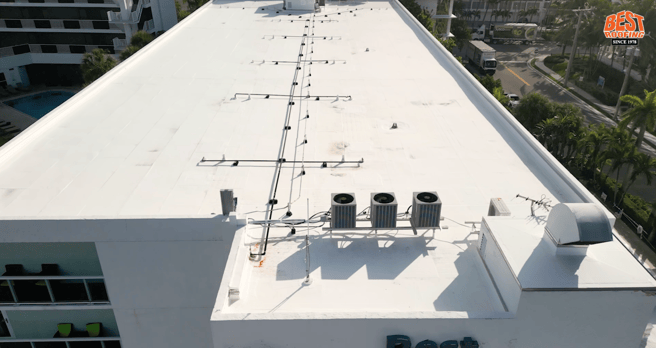
Choosing the right TPO system is a long-term financial decision for your property. The membrane, the installation method, the insulation design, and the contractor you select all directly determine whether your roof performs for 15 years or 25.
Best Roofing has worked on commercial roofing systems across Florida for over 47 years, helping property managers and building owners make informed, data-backed decisions grounded in real field experience across every Florida wind zone.
Schedule a roof evaluation with Best Roofing to get a clear, honest assessment of whether TPO is the right system for your building and what a properly specified installation would look like for your property.
Related Articles


