

A live data center cannot pause for a roof replacement. In South Florida, where High-Velocity Hurricane Zone (HVHZ) wind requirements, Miami-Dade Notice of Acceptance (NOA) mandates, and extreme heat loads compound the penetration and waterproofing risks of any large commercial facility, the margin for error is effectively zero. This article covers what makes data center roofing a different risk class, which systems perform in this climate, and what a re-roofing project on a live facility actually requires.
Why Are Data Center Roofs a Different Risk Class?
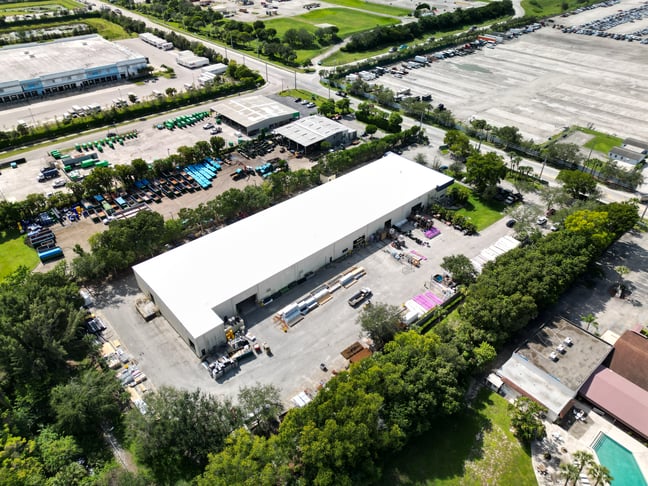
Why Are Data Center Roofs a Different Risk Class?
Data center roofs face three challenges standard commercial roofs do not: dozens to hundreds of mechanical penetrations requiring individual flashing details, concentrated structural loads from rooftop cooling equipment, and near-zero tolerance for water intrusion — where a single leak can trigger outages costing thousands of dollars per minute.
The roofing decisions you make for a data center carry consequences that don't apply to a standard commercial building. The difference is the combination of penetration density, rooftop structural loads, and the operational cost of a single leak.
How Many Penetrations Does a Data Center Roof Have?
A standard commercial office building has a handful of rooftop penetrations. A data center can have dozens to hundreds. Backup generators, automatic transfer switches, electrical conduit runs, fuel lines, cable trays, and CRAC exhaust are all standard before a single HVAC unit is added. Every penetration requires a custom flashing detail: prefabricated curb adapters and pipe boots. Generic solutions do not perform at this density.
How Does Rooftop Cooling Equipment Affect Roof Structural Load?
Cooling towers, computer room air conditioning (CRAC) units, condensers, and chiller plants are often roof-mounted to reduce the facility footprint. These systems impose concentrated structural loads that a standard commercial roofing assembly is not designed around by default. The structural support plan for rooftop equipment must be established and coordinated with the roofing scope before a membrane is selected, not after installation begins.
What HVHZ Compliance Requirements Apply to Data Center Buildings in South Florida?
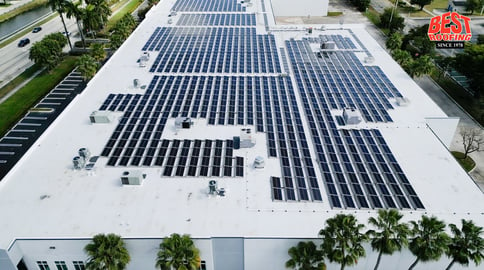
In Miami-Dade and Broward County, both fully designated HVHZ zones, every roofing product must carry a valid Miami-Dade NOA, Broward County Product Approval, or Florida Product Approval. FBC 8th Edition (2023) alone is insufficient. Design wind speeds range from 170 to 175 mph, requiring enhanced fastener patterns and impact-rated materials on every installed component.
South Florida is not a standard commercial roofing market. Florida is now the fourth-largest data center hub in the United States, with 120 facilities across 17 markets and a statewide development pipeline estimated at approximately 1,900 MW, including a multi-building campus in Palm Beach County that was initially planned at up to 3.7 million square feet before the developer scaled it back to approximately 1 million square feet following community review in December 2025.
Sources: Florida Specifier, May 2025; Blackridge Research, March 2026
That growth is happening in one of the most demanding roofing environments in the country.
What Does HVHZ Require Under FBC 8th Edition?
For data center facilities in Miami-Dade or Broward County, "FBC-compliant" is not sufficient to describe a roof system. Both counties fall entirely within the High-Velocity Hurricane Zone (HVHZ) designation, which imposes requirements beyond the statewide Florida Building Code 8th Edition (2023): enhanced fastener patterns, impact-rated materials, and a valid Miami-Dade NOA, Broward County Product Approval, or Florida Product Approval for every product installed, including membrane, insulation board, and fastener. Design wind speeds across HVHZ counties range from 170 to 175 mph. Generic "code-compliant" language does not satisfy this standard and does not produce a compliant permit package.
How Does South Florida's Climate Affect Data Center Roof Performance?
South Florida's solar exposure makes cool roof performance a hard operational cost, not a sustainability talking point. A reflective white membrane stays more than 50°F cooler than a conventional dark surface under direct sun. White roofing products reflect approximately 60–90% of sunlight back into the atmosphere.
Source: U.S. Department of Energy — Cool Roofs
In a data center environment, where cooling already accounts for a significant share of total facility power consumption, the roof's thermal performance is a variable in every energy conversation. A properly specified white membrane system reduces the solar heat gain that your rooftop HVAC system has to work against from the day it is installed.
Which Roofing System Is Best for a Data Center in South Florida?
For most South Florida data centers, a white TPO or PVC single-ply membrane is the recommended starting point: heat-welded seams, reflective surfaces that reduce cooling loads, and HVHZ compliance when installed with the correct product approvals. PVC is preferred where chemical or exhaust exposure is present. KEE offers premium longevity for long-lifecycle mandates. Modified Bitumen suits heavily trafficked maintenance rooftops.
No single system is right for every facility. The comparison below reflects performance as it applies to South Florida's compliance requirements, climate, and data center operating conditions.
|
System |
Primary advantage |
Best application |
South Florida note |
|
Heat-welded seams, energy-efficient, cost-effective |
Most data centers |
White surface; HVHZ-compliant with correct product approval |
|
|
Chemical resistance, heat-welded seams |
Facilities with generator exhaust or chemical exposure |
Same HVHZ applicability as TPO; higher material cost |
|
|
No plasticizer degradation, premium longevity |
Long lifecycle priority |
Premium system for 20-plus-year performance mandates |
|
|
Puncture resistance, foot traffic durability |
Heavily trafficked maintenance rooftops |
Requires an active maintenance program; South Florida humidity accelerates degradation without it |
Warranty note: Carlisle Authorized Applicator status enables Golden Pledge NDL warranty for qualifying installations. Neither warranty covers acts of God, hurricane damage, or failure resulting from improper maintenance. Full terms are disclosed in the contract.
Qualifying commercial roofing improvements may also be eligible for the federal Section 179D deduction through mid-2026. Consult a tax advisor to determine eligibility for your specific project.
How Do You Re-Roof a Live Data Center Without Disrupting Operations?
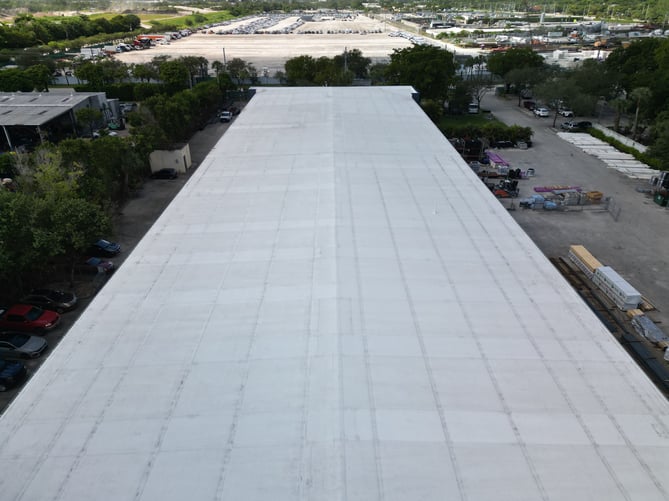
A data center re-roofing project carries an operational risk that most commercial replacements do not. The building below cannot tolerate an unplanned weather exposure event, and it generates a documentation requirement that most roofing contractors are not structured to meet.
The core risk is exposure. On a standard commercial replacement, membrane sections come off, and the new system goes down in sequence. In a data center, that sequence requires a phased approach with temporary weatherproofing active at every open section — planned before the project starts, not improvised when rain appears in the forecast. Rooftop equipment access, CRAC unit clearance, and structural coordination must be mapped and agreed upon before a single fastener is pulled.
Here's what happens next on a properly sequenced data center re-roof:
- Pre-project inspection: membrane condition, full penetration mapping, structural load documentation for all rooftop equipment
- Facility operations coordination: scheduling around maintenance windows, critical system locations, and equipment access requirements
- Phased removal and installation: one section at a time, with temporary protection active before any existing membrane is cut
- Custom flashing at every penetration: details designed for each penetration type encountered, not field-improvised solutions
- Closeout documentation package: full project audit trail, product approval references for every installed product, and inspection records
The operations team managing the facility, along with ownership above them, needs more than a certificate of completion. The deliverable includes scope-of-work documentation, inspection records, product approval references, and a complete audit trail—the standard Best Roofing provides on every commercial project.
What Should You Look for in a Roofing Contractor for a Data Center?
Not every commercial roofing contractor is equipped for this building type. Five qualifications that matter for a data center re-roofing project:
HVHZ compliance experience: Can they produce a permit package with valid Miami-Dade NOA, Broward County Product Approval, or Florida Product Approval documentation for every product specified?
Industrial penetration expertise: Have they managed high-penetration rooftops on warehouses, industrial campuses, or mission-critical facilities? The complexity of a data center requires the same level of detail and zero margin for improvisation.
Bonding capacity: A data center re-roofing project is a large, complex scope. The contractor's bonding capacity must match it. Best Roofing holds $20M per-project / $100M aggregate bonding capacity, placing it in the top 1% in the United States.
24/7 emergency response: A failing membrane on a live data center is not a scheduled repair. The contractor you hire must operate a service division that answers at 2 am. Best Roofing handles 7,000-plus service calls annually, 24 hours a day, 365 days a year.
Frequently Asked Questions
What is the best roofing system for a data center in South Florida?
For most facilities, a white TPO or PVC single-ply membrane is the starting point — heat-welded seams, a reflective surface, and HVHZ compliance with the correct product approvals. PVC is preferred where generator exhaust or chemical exposure is present. KEE is the right call for facilities with a 20-plus-year performance mandate and no tolerance for material degradation.
How do you re-roof a data center without interrupting operations?
With a phased approach: one section at a time, with temporary weatherproofing in place before any membrane is cut. Sequencing, maintenance windows, and equipment access are coordinated with your operations team before work begins — not managed reactively once the project is underway.
What are the HVHZ compliance requirements for data center roofs in Miami-Dade and Broward?
Every product installed must carry a Miami-Dade NOA, Broward County Product Approval, or Florida Product Approval. Enhanced fastener requirements and impact-rated materials apply. "FBC 8th Edition compliant" alone does not satisfy HVHZ and will not produce a valid permit package.
How does the roof affect data center cooling costs?
A reflective white membrane stays significantly cooler under direct sun than a conventional dark surface, reducing the solar heat gain your rooftop HVAC must compensate for. The roof doesn't replace your cooling system — it reduces the load on it, which matters when cooling already accounts for a major share of the facility's power draw.
Is Your Roofing Contractor Ready for This Building?
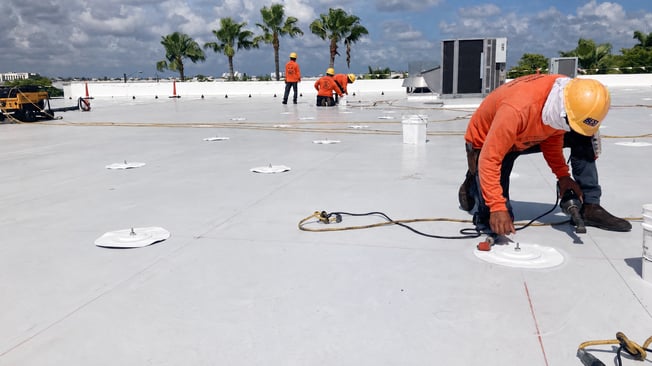
A data center roof is not where you discover your contractor's limitations. The penetration density, structural coordination, HVHZ compliance documentation, and live-facility execution plan must all be established before the project starts.
Best Roofing has been doing this in South Florida since 1978. With 2,000-plus completed commercial roofs and 7,000-plus service calls annually, we operate at the scale and depth this building type requires.
If your facility is approaching a re-roofing decision, contact us to schedule a roof assessment. The assessment covers membrane condition, full-penetration mapping, structural load documentation for rooftop equipment, and compliance status, so you have a complete picture before any project decisions are made.
Related Articles


