
Last Updated on April 30, 2026
Florida does not ask whether you are ready for a hurricane. It asks how ready your roof is.
Property managers and building owners across the state know this reality well. But knowing it and acting on it are two different things. Most roofing conversations start and end with material selection, which is only one piece of a much larger picture.
This guide goes deeper. It answers the questions that matter most before a storm season: What actually makes a roof perform under hurricane conditions? Where do systems fail, and why? And what can you do right now to reduce your exposure?
What Does "Hurricane-Resistant" Actually Mean for a Commercial Roof?
The term "hurricane-resistant" is used loosely in the industry, but it has a specific technical meaning when applied to commercial roofing systems.
A roof that is "hurricane-resistant" is one where all four of those factors have been engineered together. It is not a product you buy off a list.
The three forces working against your roof in a hurricane:
- Positive pressure: Wind hits the windward wall and pushes up on the roof deck from below.
- Negative pressure (uplift): Wind traveling across the roof surface creates suction, pulling the membrane or panels away from the deck.
- Water intrusion: Sustained rain, wind-driven at high velocity, finds any opening: seams, flashings, penetrations, edges.
Roofs fail when one or more of these forces exceeds the capacity of the weakest element in the system. This is why material selection is not the starting point. System design is.
Why Roof Geometry Shapes Performance Before a Single Material Is Chosen
Residential construction has long favored hip roofs for hurricane performance, because the four-sided slope distributes wind load more evenly and reduces the total surface exposed to uplift.
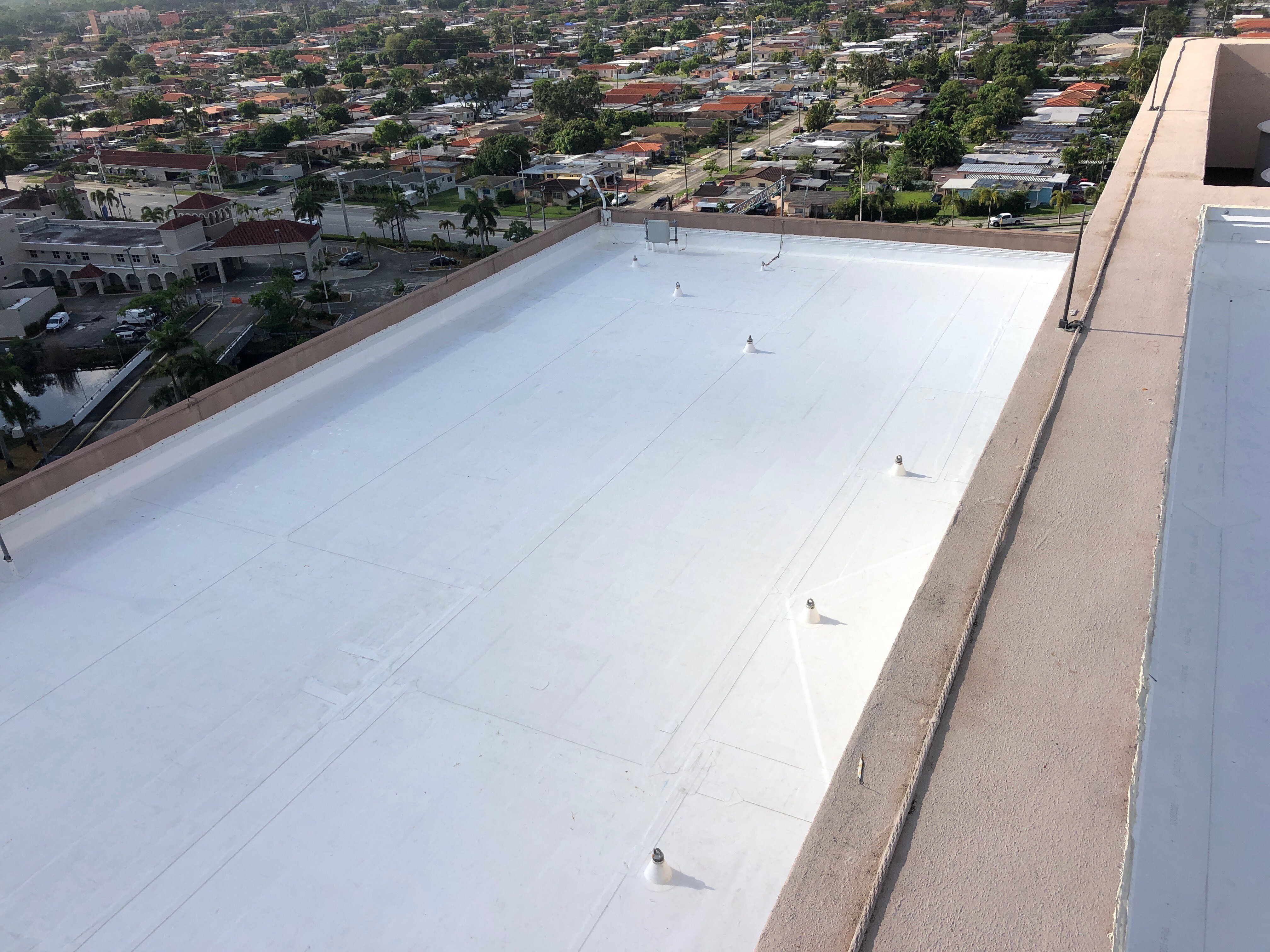
Commercial buildings typically use flat or low-slope systems, so the geometry question becomes one of edge control and drainage rather than pitch.
Key design principles for low-slope commercial roofs in hurricane zones:
- Tapered insulation systems direct water away from the field and toward drains, reducing the standing water load during and after a storm.
- Reinforced perimeter and corner details reduce the zone where wind can get under the membrane, which is the most common initiation point for catastrophic failure.
- Roof-to-wall connections must be engineered for the building's wind zone, not just the general region.
One of the most underappreciated design decisions is parapet height. A well-designed parapet can meaningfully reduce wind uplift forces at the roof edge by redirecting airflow. An undersized or deteriorated parapet offers little protection and can become a projectile hazard during a storm.
How the Most Common Commercial Roofing Systems Actually Perform in Hurricanes
No system is universally best. Each one performs differently based on design, installation quality, and maintenance history.
|
System |
Wind Performance |
Key Strength |
Watch Out For |
Best Fit |
|
TPO |
Strong when properly fastened |
Heat-welded seams; reflective surface reduces thermal cycling stress |
Highly sensitive to installation quality; poor welds fail early |
Large commercial roofs seeking energy efficiency |
|
PVC |
Very strong seam integrity |
Exceptional chemical and UV resistance; long seam weld strength |
Higher material cost; can become less flexible over time under prolonged UV and thermal exposure, depending on formulation |
Environments with chemical exposure |
|
Modified Bitumen |
Multi-layer durability |
Redundant waterproofing layers; excellent puncture resistance |
A heavier system adds load; torch-applied installation requires skilled crews |
High foot-traffic rooftop areas |
|
Structural Metal |
Excellent wind resistance |
Among the highest uplift ratings available when properly engineered and installed, with a 40-70 year lifespan |
Higher upfront cost; not suitable for flat roof conversions |
Sloped applications, new construction, warehouses |
For a deeper look at one of the most widely used single-ply options, what TPO roofing is and how it performs is a useful starting point.
The Attachment Question: Why How a Roof Is Fastened Matters More Than What It Is Made Of
Wind uplift failure rarely starts in the middle of a roof. It starts at the point where the system connects to the structure, or fails to.
What a properly engineered fastening system looks like:
- Fastener patterns are designed for the specific wind zone of the building, not a generic regional standard. Florida has multiple wind zones with meaningfully different requirements.
- Perimeter and corner zones receive increased fastener density. These areas can experience significantly higher uplift forces than the roof field, as defined by ASCE 7 wind design zones.
- The deck itself is assessed before installation. A membrane fastened to a deteriorated or delaminated deck will fail regardless of the membrane's quality.
- For mechanically attached systems, row spacing and fastener type are specified and verified during installation.
Fully adhered vs. mechanically attached: which is better for hurricane exposure?
Fully adhered systems bond the membrane directly to the insulation substrate, reducing the potential for air movement beneath the membrane that can contribute to uplift pressure. In high-wind environments, this is a significant advantage
Mechanically attached systems rely on fasteners and plates. When properly engineered, they perform well. But they introduce a dependency on the integrity of fasteners over time, making maintenance history even more critical.
Neither system is categorically superior. The right choice depends on the building structure, deck condition, budget, and intended service life.
Where Roofs Actually Fail: A Closer Look at the Weak Points
Understanding failure patterns is the most direct way to prioritize preventative action. Post-storm forensic reports consistently identify the same five areas.
1. Roof edges and perimeter terminations: This is the single most common failure point. Wind pressure at the roof edges is dramatically higher than in the field of the roof. If the edge metal, coping, or perimeter fastening is inadequate or deteriorated, failure cascades inward rapidly.
2. Penetration flashings: Every HVAC unit, pipe, drain, or vent that passes through the roof creates a potential entry point. The flashings around these penetrations are subject to constant movement as the roof expands and contracts with temperature changes. Over time, they can separate, crack, or lift. Wind-driven rain finds these gaps immediately.
3. Seams and field splices: For single-ply membranes, seam integrity is fundamental. Improperly welded or adhered seams can hold for years under normal conditions but open under storm stress. This is one reason that installation quality and contractor experience matter so much for long-term performance.
4. Drain and scupper conditions: Standing water is a load problem. A roof that drains poorly adds weight during a storm, which compounds structural stress. Debris-blocked drains during a hurricane can cause water accumulation that significantly increases structural load and may exceed design limits in severe cases.
5. Rooftop equipment anchorage: HVAC units, satellite dishes, exhaust fans, and other rooftop equipment become projectiles if not properly anchored. Beyond the immediate damage, they tear membranes and create massive openings when they shift or lift off.
What Can You Actually Do Before Hurricane Season? A Practical Checklist
The window between hurricane seasons is when risk reduction actually happens. Once a storm is 48 hours out, the options are limited.
Schedule a formal roof inspection with documentation. A visual inspection from the ground is not sufficient. A qualified contractor should walk the roof, document conditions photographically, and provide a written assessment of vulnerabilities. This also establishes a baseline condition record, which is important for insurance purposes.
Regular commercial roof maintenance is not just about extending lifespan. It is the primary mechanism for catching vulnerabilities before they become storm failures.
Address edge metal and perimeter conditions If an inspection reveals loose, corroded, or improperly installed edge metal, this should be the first priority. Perimeter failures are fast, catastrophic, and preventable.
Reseal and reinforce penetration flashings. All flashings around penetrations should be inspected and resealed if there is any evidence of separation, cracking, or adhesion loss. This is relatively low-cost work that eliminates a common failure point.
Clear all drains, scuppers, and gutters. Remove debris from every drainage component on the roof. Confirm that all drains are functioning and that the roof profile actually directs water toward them.
Secure all rooftop equipment: Verify that HVAC equipment, satellite dishes, and any other rooftop installations are properly anchored.
Review your insurance coverage in light of current Florida code requirements; insurance requirements are closely tied to building code compliance. Understanding where your roof stands relative to current Florida roof-replacement law can determine whether a partial repair or a full replacement is the right investment.
Frequently Asked Questions About Hurricane Roofing Performance
What is the best roofing material for a hurricane in Florida?
There is no single best material. The roofing system that performs best in a hurricane is the one that is appropriately engineered for your specific building, properly installed, and consistently maintained. For commercial low-slope applications, fully adhered TPO and PVC systems with reinforced perimeter details have strong track records. For sloped applications, structural metal roofing offers the highest wind uplift ratings.
How do I know if my commercial roof is ready for hurricane season?
The only reliable way to know is through a professional inspection that documents current conditions. Key indicators of risk include visible edge metal deterioration, evidence of standing water, any separation at penetration flashings, and rooftop equipment that has not been inspected for anchorage.
Does a newer roof perform better in a hurricane?
Not necessarily. A newer roof installed without proper wind uplift design will underperform an older roof that has been well maintained and is built to the wind zone requirements. Age is a factor in material integrity, but it is secondary to design and maintenance quality.
What wind speed should a Florida commercial roof be designed for?
This depends on the building's location within Florida. The Florida Building Code specifies wind speed requirements by county and exposure category. South Florida properties in coastal zones may require design wind speeds of 160 mph or higher, depending on location, exposure, and building classification
Can I hurricane-proof my existing roof without replacing it?
In many cases, yes. If the existing roof is structurally sound and the membrane is in acceptable condition, targeted reinforcement of perimeters, penetrations, and equipment anchorage can meaningfully improve performance. A full replacement is not always necessary or the most cost-effective path to risk reduction.
How does roof maintenance affect hurricane performance?
Directly and significantly. A well-maintained roof enters storm season with intact seams, sealed penetrations, clear drainage, and secured perimeters. A neglected roof carries existing vulnerabilities into every storm.
What to Look for in a Roofing Contractor for Hurricane-Zone Work
Questions worth asking before engaging a contractor:
- Are they specifically licensed and insured in Florida?
- Can they demonstrate experience with hurricane wind zone design requirements for your county?
- Do they use manufacturer-certified installers for the system they are proposing?
- Can they provide uplift test data or third-party certification for the proposed assembly?
- Do they offer documented inspection reports, not just verbal assessments?
The NRCA's contractor certification programs and manufacturer-authorized contractor designations are reasonable indicators of technical competency.
The Time to Prepare Is Not When the Storm Is Coming

Most of the risk-reduction options available to you occur before hurricane season, not during it. The decisions that protect your building and your tenants are made in the months of relative calm, through inspections, targeted maintenance, and informed capital planning.
Best Roofing has worked with commercial property owners and managers across Florida for over 45 years. If you want a clear, documented assessment of how your building is positioned for the coming storm season, the right starting point is a professional evaluation.
Schedule a roof evaluation with Best Roofing and get the information you need to make sound, long-term decisions.
Related Articles